

Introduction
A civil engineering drawing represents the designer’s intent, but a construction site represents reality. Between the drawing board and the actual execution lie numerous challenges such as soil conditions, workmanship quality, material availability, weather conditions, safety concerns, equipment limitations, and human errors.
One of the biggest lessons every site engineer learns is that construction is not just about following drawings; it is about converting design intent into a safe, durable, and practical structure.
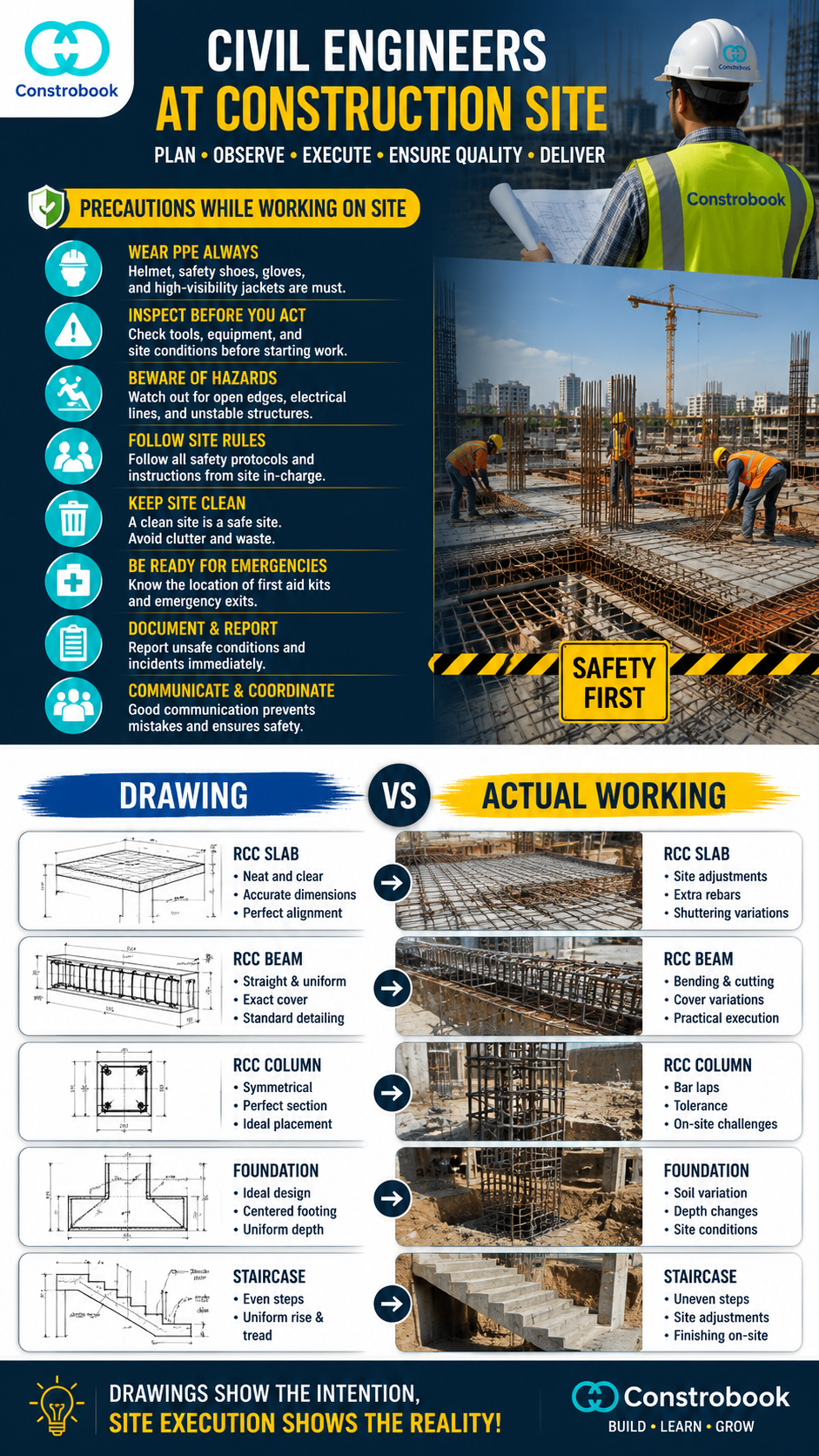
The image above perfectly illustrates this reality. Drawings show ideal conditions, while actual site execution involves adjustments, coordination, troubleshooting, and constant supervision.
This article provides a detailed guide for civil engineers, site engineers, supervisors, contractors, and fresh graduates entering the construction industry.
—
Why Site Knowledge Matters More Than Drawings Alone
Many engineering graduates believe that knowing AutoCAD drawings, RCC details, and IS codes is enough.
However, on-site construction involves:
Labour management
Material control
Safety implementation
Quality checks
Equipment coordination
Client communication
Consultant coordination
Problem solving
A structure succeeds not because of good drawings alone but because of proper execution.
A successful site engineer spends:
20% time studying drawings
80% time ensuring correct execution
—
Site Safety: The First Responsibility
No project is successful if it causes injury or loss of life.
Safety is not an additional activity. It is part of construction.
Essential Safety Precautions
1. Always Wear PPE
PPE (Personal Protective Equipment) includes:
Safety helmet
Reflective jacket
Safety shoes
Hand gloves
Safety goggles
Ear protection
Many accidents occur because workers ignore basic PPE requirements.
Practical Tip
Never enter a site area without safety shoes and a helmet, even for a five-minute inspection.
—
2. Inspect Work Area Before Starting
Before commencing work:
Check:
✓ Open pits
✓ Loose materials
✓ Exposed electrical wires
✓ Unsafe scaffolding
✓ Equipment condition
✓ Access routes
Practical Tip
Spend 10 minutes inspecting the site every morning. This habit prevents many accidents.
—
3. Work at Height Safely
Falls are among the most common construction accidents.
Before working at height:
Use full body harness
Check lifelines
Verify scaffolding stability
Install guard rails
Provide safety nets
Common Mistake
Workers often remove harnesses because they feel uncomfortable.
A site engineer must strictly enforce compliance.
—
4. Electrical Safety
Temporary electrical systems are common causes of accidents.
Ensure:
Proper earthing
MCB protection
Waterproof connections
Insulated cables
Licensed electricians
Golden Rule
Never allow damaged cables on site.
—
5. Housekeeping
A clean site is a safe site.
Poor housekeeping causes:
Trips
Falls
Material damage
Delays
Daily cleaning should be mandatory.
—
Drawing vs Actual Site Reality
1. RCC Slab
In Drawings
The slab appears:
Straight
Symmetrical
Perfectly aligned
All dimensions seem simple.
On Site
Challenges include:
Bar bending errors
Reinforcement shifting
Uneven shuttering
Service openings
Congested reinforcement
Best Practice
Before concrete pouring:
Conduct a slab checklist.
Verify:
✓ Reinforcement spacing
✓ Cover blocks
✓ Beam dimensions
✓ Electrical conduits
✓ Plumbing sleeves
✓ Shuttering levels
—
2. RCC Beams
In Drawings
Beam reinforcement appears neat and organized.
On Site
Actual problems include:
Congestion at junctions
Incorrect stirrup spacing
Reinforcement cutting errors
Cover deficiencies
Best Practice
Always verify:
Development length
Anchorage
Lap lengths
Cover thickness
A small mistake in beam reinforcement can significantly affect structural performance.
—
3. RCC Columns
In Drawings
Columns are perfectly vertical.
On Site
Issues often include:
Improper alignment
Bent starter bars
Incorrect lap locations
Honeycombing
Best Practice
Check plumb after every shuttering operation.
A slight deviation at lower floors becomes a major problem at higher levels.
—
4. Foundations
In Drawings
The soil is assumed to be ideal.
On Site
Reality may involve:
Water seepage
Soft soil pockets
Hard rock
Underground utilities
Existing structures
Best Practice
Never proceed with foundation concreting without verifying:
Excavation depth
Soil bearing condition
PCC levels
Reinforcement
—
5. Staircase Construction
In Drawings
Every tread and riser is identical.
On Site
Problems often occur due to:
Incorrect levels
Uneven shuttering
Architectural modifications
Best Practice
Construct a sample step before casting.
This prevents costly rework.
—
Quality Control Tips Every Site Engineer Must Follow
Concrete Quality
Before pouring concrete:
Check Slump
Too low:
Poor workability
Too high:
Segregation risk
Maintain the specified slump range.
—
Check Mix Design
Never assume the batching plant is always correct.
Verify:
Grade
Cement content
Admixture dosage
Water-cement ratio
—
Cube Testing
Always cast test cubes.
Typical testing schedule:
7 Days
28 Days
Cube results provide actual strength verification.
—
Reinforcement Quality Checks
Before concreting:
Check:
✓ Bar diameter
✓ Spacing
✓ Lapping
✓ Anchorage
✓ Cover
✓ Bending shape
Important Fact
Many structural failures begin with reinforcement detailing mistakes rather than concrete quality issues.
—
Site Coordination: The Hidden Skill
Technical knowledge alone is insufficient.
A successful engineer coordinates between:
Client
Architect
Structural consultant
MEP consultant
Contractor
Vendors
Labour teams
Poor coordination causes:
Delays
Rework
Cost overruns
—
Common Mistakes Fresh Engineers Make
1. Trusting Drawings Blindly
Always verify site conditions.
Drawings may not reflect latest modifications.
—
2. Avoiding Labour Interaction
Workers often have practical knowledge developed through years of experience.
Respect their input.
—
3. Not Maintaining Records
Always maintain:
DPR (Daily Progress Report)
Material records
Cube test records
Inspection records
Documentation protects engineers during disputes.
—
4. Ignoring Safety
Many young engineers focus only on progress.
Safety must always come first.
No deadline is worth a serious accident.
—
Daily Routine of an Effective Site Engineer
Morning
Safety inspection
Labour allocation
Material verification
Review daily targets
During Work
Check dimensions
Monitor quality
Resolve issues
Coordinate teams
Before Concreting
Final reinforcement inspection
Shuttering inspection
Service clearance
Evening
Record progress
Update DPR
Plan next day activities
—
Practical Site Tips Learned from Experience
Tip 1
Never approve concrete without personally inspecting reinforcement.
—
Tip 2
Always carry:
Measuring tape
Marker
Calculator
Notebook
Drawing set
—
Tip 3
Take photographs before and after critical activities.
Photographic records save countless disputes later.
—
Tip 4
Walk the site multiple times daily.
Problems discovered early are cheaper to fix.
—
Tip 5
Understand “why” before asking workers to change something.
Workers cooperate more when they understand the reason.
—
Tip 6
Never rely only on verbal instructions.
Important instructions should be documented.
—
Tip 7
Verify dimensions physically.
Do not assume that previous work was executed correctly.
—
The Reality of Construction in India
Indian construction projects face unique challenges:
Labour turnover
Weather disruptions
Material fluctuations
Tight budgets
Aggressive timelines
Multi-language workforce
Because of these factors, site engineers must develop:
Leadership
Communication
Decision-making
Adaptability
The best engineers are not those who know the most theory; they are those who consistently solve problems while maintaining safety and quality.
—
The Most Important Lesson
A drawing is a guide.
A site is reality.
The role of a civil engineer is to bridge the gap between the two.
Successful construction depends on three pillars:
Safety
No injury should ever be accepted as part of the job.
Quality
Every activity must meet specifications and standards.
Execution
Work must be completed efficiently and correctly.
When these three pillars work together, a project becomes successful.
—
Conclusion
The difference between a drawing and actual construction is where real engineering begins. Drawings provide direction, but site execution requires judgment, observation, leadership, and practical knowledge. Every beam, slab, column, foundation, and staircase presents challenges that cannot always be predicted on paper.
For young civil engineers entering the field, the key to success is simple:
Study the drawing, understand the intent, inspect the site, communicate effectively, prioritize safety, and never stop learning from actual execution.
Remember:
“Drawings show the intention. Site execution shows the reality. Great engineers master both.”
Article prepared for Constrobook – Supporting Leadership in Construction & Infrastructure.
Website: www.constrobook.com