
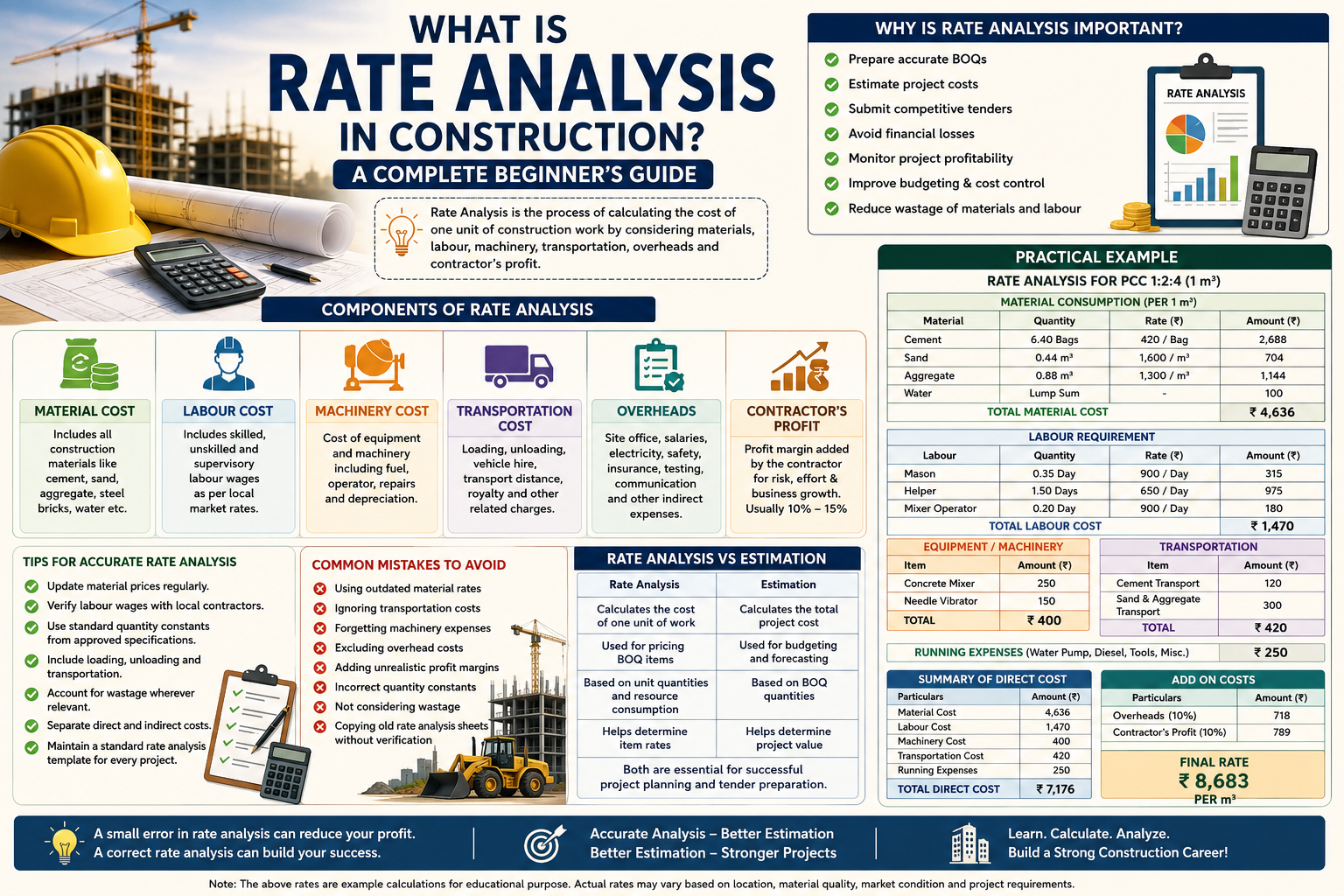
If you have ever wondered how contractors decide the price of a construction item, the answer is Rate Analysis.
Whether you are a Civil Engineer, Quantity Surveyor, Contractor, Builder, Estimator, or Engineering Student, understanding rate analysis is one of the most valuable skills in the construction industry. It helps prepare accurate BOQs (Bill of Quantities), estimate project costs, submit competitive tenders, and control project budgets.
In simple terms, Rate Analysis is the process of calculating the total cost of completing one unit of construction work by considering materials, labour, machinery, transportation, overheads, and contractor’s profit.
Instead of guessing the price, rate analysis uses actual quantities and market rates to determine a realistic cost.
Why is Rate Analysis Important?
A proper rate analysis helps you:
- Prepare accurate BOQs
- Estimate project costs before construction starts
- Avoid financial losses
- Submit competitive tender quotations
- Monitor project profitability
- Reduce wastage of materials and labour
- Improve budgeting and cost control
Without proper rate analysis, even a small error in pricing can significantly reduce project profits.
Basic Components of Rate Analysis
Every construction item consists of the following cost components:
1. Material Cost
Material cost generally contributes 50–70% of the total item cost.
Examples include:
- Cement
- Sand
- Aggregate
- Steel
- Bricks or Blocks
- Water
- Admixtures
Always use the latest local market rates because prices vary from city to city.
2. Labour Cost
Labour charges depend upon:
- Mason
- Helper
- Carpenter
- Bar Bender
- Electrician
- Plumber
- Skilled Labour
- Unskilled Labour
Daily wage rates differ across Indian states and project locations.
3. Equipment and Machinery Cost
Construction equipment also contributes to the final cost.
Examples:
- Concrete Mixer
- Vibrator
- Excavator
- Transit Mixer
- Needle Vibrator
- Water Pump
- Cutting Machine
Include fuel, operator wages, maintenance, and depreciation where applicable.
4. Transportation Cost
Transportation includes:
- Material loading
- Unloading
- Vehicle hire
- Fuel charges
- Lead distance
- Royalty (where applicable)
Transportation costs can significantly increase in remote project locations.
5. Overheads
Overheads are indirect expenses required to run the project.
Examples include:
- Site Engineer Salary
- Supervisor Salary
- Office Expenses
- Safety Equipment
- Electricity
- Site Office Rent
- Internet & Communication
- Insurance
- Security
- Testing Charges
Normally, overheads range between 5% and 15% depending on project size.
6. Contractor’s Profit
After calculating all expenses, contractors generally add 10%–15% profit, depending on competition, project risk, and market conditions.
Practical Example: Rate Analysis for PCC (Plain Cement Concrete) 1 m³
Item: PCC 1:2:4
Material Consumption (Approximate)
| Material | Quantity (Constant per 1 m³) | Approx. Rate (₹) | Amount (₹) |
|---|---|---|---|
| Cement | 6.40 Bags | 420/Bag | 2,688 |
| Sand | 0.44 m³ | 1,600/m³ | 704 |
| Aggregate | 0.88 m³ | 1,300/m³ | 1,144 |
| Water | Lump Sum | – | 100 |
Material Cost = ₹4,636
Labour Requirement
| Labour | Quantity | Rate | Amount |
|---|---|---|---|
| Mason | 0.35 Day | ₹900 | ₹315 |
| Helper | 1.50 Days | ₹650 | ₹975 |
| Mixer Operator | 0.20 Day | ₹900 | ₹180 |
Total Labour Cost = ₹1,470
Machinery Cost
- Concrete Mixer = ₹250
- Needle Vibrator = ₹150
Total Machinery Cost = ₹400
Transportation
- Cement Transport = ₹120
- Sand & Aggregate Transport = ₹300
Transportation = ₹420
Running Expenses
- Water Pump
- Diesel
- Small Tools
- Miscellaneous Consumables
Running Expenses = ₹250
Total Direct Cost
| Component | Amount |
|---|---|
| Materials | ₹4,636 |
| Labour | ₹1,470 |
| Machinery | ₹400 |
| Transportation | ₹420 |
| Running Expenses | ₹250 |
Direct Cost = ₹7,176
Add Overheads (10%)
₹718
Add Contractor’s Profit (10%)
₹789
Final Rate
Total Cost = ₹8,683 per m³
Note: These rates are sample calculations for educational purposes. Actual rates vary based on city, project location, material quality, labour availability, taxes, transportation distance, and market fluctuations.
Common Mistakes Beginners Make
Many beginners make these errors:
- Using outdated material rates
- Ignoring transportation costs
- Forgetting machinery expenses
- Excluding overhead costs
- Adding unrealistic profit margins
- Incorrect quantity constants
- Not considering wastage
- Copying old rate analysis sheets without verification
Even small omissions can affect the profitability of a project.
Tips for Accurate Rate Analysis
- Update material prices regularly.
- Verify labour wages with local contractors.
- Use standard quantity constants from approved specifications where applicable.
- Include loading, unloading, and transportation.
- Account for wastage wherever relevant.
- Separate direct and indirect costs.
- Maintain a standard rate analysis template for every project.
Difference Between Rate Analysis and Estimation
| Estimation | Rate Analysis |
|---|---|
| Calculates the total project cost | Calculates the cost of one unit of work |
| Used for budgeting | Used for pricing BOQ items |
| Based on BOQ quantities | Based on unit quantities and resource consumption |
| Helps determine project value | Helps determine item rates |
Both are essential for successful project planning and tender preparation.
Conclusion
Rate Analysis is one of the most fundamental skills in construction cost management. It allows engineers, quantity surveyors, and contractors to determine realistic item rates by considering materials, labour, equipment, transportation, overheads, and profit.
Mastering rate analysis leads to more accurate BOQs, stronger tender submissions, improved budgeting, and better project profitability. As market prices change frequently, always verify current rates and review your calculations before finalizing any estimate.
If you’re beginning your journey in quantity surveying or construction estimation, learning rate analysis thoroughly will provide a strong foundation for your career.
Frequently Asked Questions (FAQs)
1. What is Rate Analysis in construction?
Rate Analysis is the process of calculating the cost of one unit of construction work by considering materials, labour, machinery, transportation, overheads, and contractor’s profit.
2. Why is Rate Analysis important?
It helps prepare accurate BOQs, estimate project costs, submit competitive tenders, control budgets, and improve profitability.
3. What are the main components of Rate Analysis?
Material cost, labour cost, machinery, transportation, running expenses, overheads, and contractor’s profit.
4. Is Rate Analysis the same as Estimation?
No. Estimation calculates the total project cost, while Rate Analysis calculates the cost of a single BOQ item.
5. Who should learn Rate Analysis?
Civil Engineers, Quantity Surveyors, Contractors, Builders, Estimators, Project Managers, and Civil Engineering Students.
Primary SEO Keywords: Rate Analysis in Construction, Rate Analysis Formula, Construction Cost Estimation, BOQ Rate Analysis, Quantity Surveying, Civil Engineering Estimation, Construction Costing, Tender Estimation, BOQ Preparation, Construction Cost Management.
Related Keywords: Material Cost Calculation, Labour Rate Analysis, Construction Overheads, Contractor Profit, Estimation and Costing, Quantity Surveyor Guide, Civil Engineering Basics, BOQ Pricing India, Construction Tender Preparation.